
5G CPE vs 4G Router: How to Choose for Your Deployment
A practical guide for ISPs and integrators deciding between 5G CPE and 4G LTE routers for fixed wireless deployments.
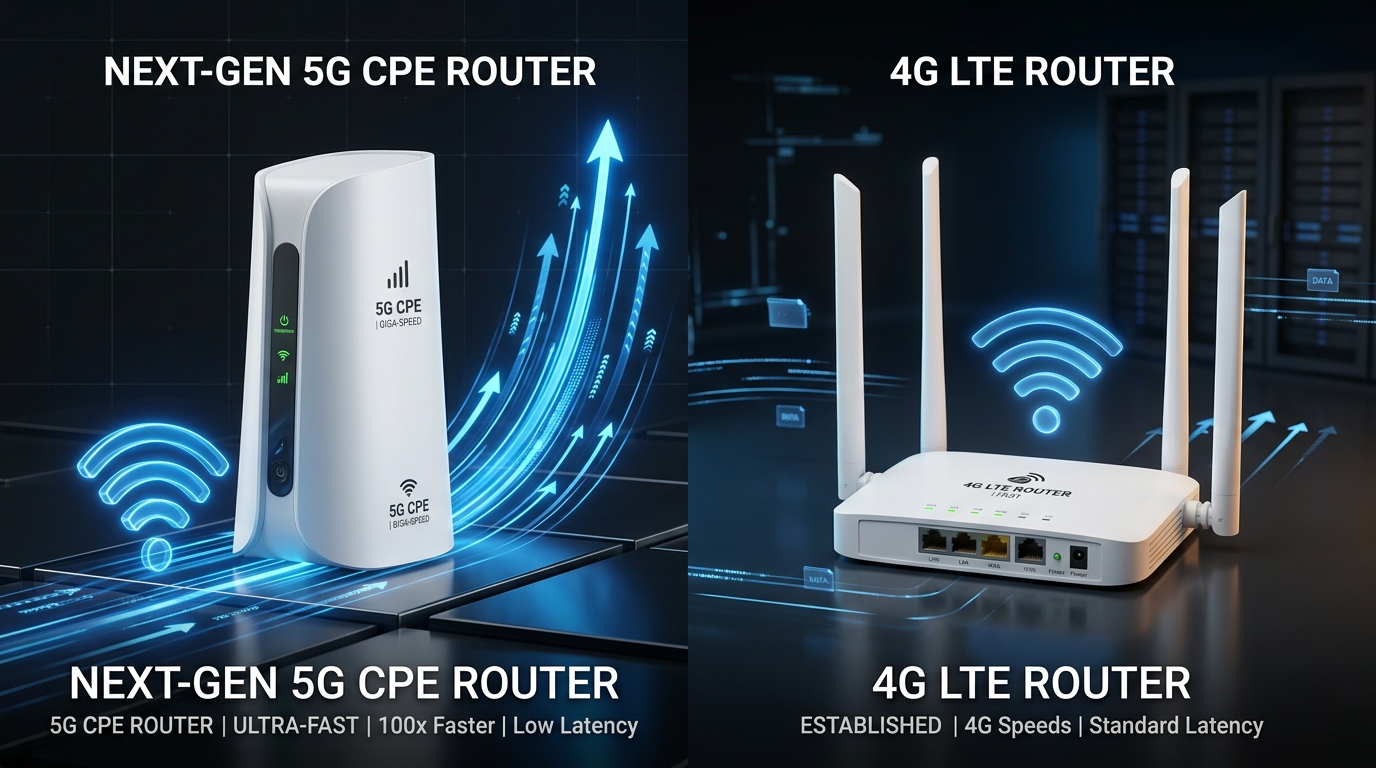
For Internet Service Providers (ISPs), Mobile Virtual Network Operators (MVNOs), and system integrators deploying Fixed Wireless Access (FWA) and enterprise connectivity, choosing between 5G Customer Premises Equipment (CPE) and 4G LTE routers is one of the most critical hardware procurement decisions.
While 5G technology delivers multi-gigabit throughput and fiber-like low latency, 4G LTE remains an exceptionally stable, cost-effective, and globally accessible workhorse. Selecting the optimal platform requires balancing network coverage, subscriber bandwidth tiers, hardware capital expenditures (CapEx), and total cost of ownership (TCO).
This engineering guide examines the technical distinctions, architectural tradeoffs, real-world deployment scenarios, and hardware selection criteria to help operators specify the right connectivity mix.
5G CPE vs. 4G LTE Router: Direct Comparison Matrix
| Technical & Operational Metric | 5G CPE (AceTel R5089 / R1801K) | 4G LTE Router (AceTel R1260S / R520) |
|---|---|---|
| Cellular Standards | 3GPP Release 15 / 16 / 17 (5G SA & NSA) | 3GPP Release 8 through 12 (LTE Cat 4 / Cat 6 / Cat 12) |
| Peak Downlink Speed | 1.8 Gbps to 3.4+ Gbps | 150 Mbps (Cat 4) to 600 Mbps (Cat 12) |
| Peak Uplink Speed | 250 Mbps to 900+ Mbps | 50 Mbps (Cat 4) to 100 Mbps (Cat 12) |
| Air Interface Latency | < 10–15 ms (URLLC capable) | 30–60 ms |
| Local Wi-Fi Generation | Dual-Band Wi-Fi 6 (802.11ax) or Wi-Fi 7 | Dual-Band Wi-Fi 5 (802.11ac) or Wi-Fi 4 (802.11n) |
| Concurrent Wi-Fi Clients | 64 to 128+ devices | 32 to 64 devices |
| Backward Compatibility | Full fallback to 4G LTE Cat 16 / Cat 19 | Fallback to 3G WCDMA / 2G GSM |
| Hardware CapEx (BOM) | Higher initial device cost | Highly economical (low initial CapEx) |
| Antenna Architecture | 4x4 to 8x8 DL MIMO (Omni internal / external) | 2x2 DL MIMO (Internal or external whip) |
| Target Service Tier | Premium gigabit home broadband, enterprise WAN | Budget residential FWA, industrial SCADA, backup WAN |
| Lifecycle Longevity | 5–8+ years (carrier 5G expansion phase) | 3–5 years (maintenance and transition phase) |
Core Technical Differences
1. Throughput & Spectral Efficiency
Modern 5G CPE leverages massive Multiple-Input Multiple-Output (MIMO) and wideband Carrier Aggregation (up to 100–300 MHz channel bandwidths in Sub-6GHz), achieving peak download rates exceeding 3 Gbps. In contrast, 4G LTE Cat 6 platforms aggregate up to two 20 MHz carriers (40 MHz total), maxing out around 300 Mbps under pristine RF conditions.
2. Network Latency & Quality of Service (QoS)
5G Standalone (SA) architecture introduces a dedicated cloud-native core network that drops round-trip latency to sub-15ms levels. This performance leap makes 5G CPE well suited for competitive online gaming, virtual desktop infrastructure (VDI), real-time financial trading, and interactive telemedicine. 4G LTE connections typically experience 35–65ms ping times with higher jitter during cell tower congestion.
3. Client Density & In-Premises Wi-Fi
Because 5G CPE routers are built to process gigabit cellular pipelines, they are paired with high-performance Wi-Fi 6 (802.11ax) chipsets featuring OFDMA, MU-MIMO, and 1024-QAM. A single unit such as the AceTel R1801K effortlessly connects 64+ smart home or office devices simultaneously without buffer bloat. Standard 4G routers typically deploy Wi-Fi 4 or Wi-Fi 5, adequate for basic household streaming but constrained under dense client loads.
Deployment Decision Framework: Which Platform Fits Your Network?
                                [ Operator Hardware Assessment ]
                                                │
                       Is Sub-6GHz 5G Coverage Available & Stable?
                                        │               │
                                       YES              NO
                                        │               │
               Are Subscribers Paying For >100 Mbps?    ▼
                        │               │     [ Deploy 4G LTE Router ]
                       YES              NO     (R1260S Cat 6 / R520 Cat 4)
                        │               │     - Rural coverage areas
                        ▼               ▼     - Cost-sensitive prepaid
             [ Deploy 5G CPE ]    [ Cost vs Future-Proofing? ]
             (R5089 / R1801K)           │               │
             - Premium FWA       Future-Ready      Lowest CapEx
             - Enterprise WAN           │               │
                                        ▼               ▼
                                 [ 5G CPE ]      [ 4G LTE Cat 6 ]
Key Use Cases
When 5G CPE is the Clear Winner
- Fiber Replacement for Residential Broadband (FWA): In suburban and urban areas where trenching fiber-optic cable is prohibitively expensive or slow, deploying AceTel R5089 5G CPE allows operators to launch commercial 300 Mbps to 1 Gbps broadband tiers immediately upon customer sign-up.
- Branch Office Primary WAN: Enterprise branch locations, digital bank branches, and medical clinics require multi-gigabit throughput with VPN encryption. The AceTel R1801K 5G Router delivers wireline-equivalent performance with instant activation.
- High-Density Hospitality & MDU Venues: In multi-dwelling environments and hotel backup networks, 5G gateways provide heavy concurrent throughput to sustain guest connectivity during fiber outages.
When 4G LTE Routers Remain the Pragmatic Choice
- Rural & Emerging Market Fixed Wireless: In territories where 5G rollout remains several years away, deploying cost-effective LTE Cat 4 (AceTel R520) or Cat 6 (AceTel R1260S) routers provides subscribers with dependable 30–80 Mbps service while keeping hardware subsidized costs manageable.
- Automated Machine-to-Machine (M2M) & SCADA: For smart grid monitoring, solar farm sensors, water treatment telemetry, and digital billboards, bandwidth demands rarely exceed 5–10 Mbps. A reliable 4G cellular terminal delivers decades of trouble-free connectivity at a fraction of 5G component costs.
- Retail Point-of-Sale (POS) & ATM Backup: Payment processing packets require tiny bandwidth but 100% network uptime. The internal battery backup option available on the AceTel R1260S guarantees that credit card transactions continue processing even during electrical grid brownouts.
Total Cost of Ownership (TCO) Analysis
When evaluating unit pricing, operators must factor in the total lifetime cost of the subscriber premises:
- Customer Acquisition & Churn: Premium subscribers expecting high-definition streaming will cancel service if saddled with an underpowered 4G router. Providing a high-spec 5G CPE dramatically cuts first-year churn rates.
- Future-Proofing Capital: A 5G CPE deployed today on an NSA network will automatically transition to faster 5G SA networks as carriers upgrade their tower basebands, extending device service life to 6+ years.
- Standardized Device Management: Both AceTel 5G CPE and 4G LTE routers support universal TR-069 and TR-181 ACS protocols, allowing network operations centers (NOCs) to monitor signal strength (RSRP, RSRQ, SINR), execute remote band locking, and push automated firmware patches across mixed fleets from a single dashboard.
Frequently Asked Questions (FAQ)
Can a 5G CPE operate in areas where only 4G LTE coverage is available?
Yes. All AceTel 5G CPE routers integrate multi-mode baseband processors that provide full backward compatibility. If a 5G carrier signal is temporarily lost or unavailable at the deployment site, the device automatically falls back to 4G LTE (Cat 16 to Cat 20), maintaining continuous high-speed data transmission.
Is 5G CPE installation as simple as a 4G router?
Yes. Both 5G CPE and 4G routers operate on a plug-and-play basis: insert an activated data SIM card and power on the device. For indoor installations with challenging RF conditions, AceTel 5G CPE models feature high-gain internal 12-antenna arrays and signal strength LED meters to help subscribers find the optimal window placement without professional installer visits.
How does power consumption compare between 5G CPE and 4G routers?
5G modems and multi-core Wi-Fi 6 processors require more computational energy than older 4G chipsets. A typical 5G CPE consumes 12W to 18W under heavy load, whereas an LTE Cat 4 router typically draws 4W to 8W. For solar-powered or remote off-grid installations, 4G LTE routers are often chosen specifically for their lower energy footprint.
Can telecom operators customize the Web GUI and band configurations on both platforms?
Yes. AceTel provides end-to-end OEM/ODM white-label manufacturing across both 5G CPE and 4G router lines. Operators can specify custom casing branding, operator-locked APNs, customized Web GUI management dashboards, and specific regional band filter calibrations.
Recommended Hardware Platforms
- Flagship Enterprise 5G CPE: AceTel R5089 5G CPE Router (Qualcomm X62, Wi-Fi 6 AX3000)
- Residential Desktop 5G FWA: AceTel R1801K WiFi 6 AX1800 5G Router (12 Internal Antennas)
- Cost-Optimized LTE-A Cat 6: AceTel R1260S 4G Cat6 CPE Router (Battery Backup Option)
- Industrial Automation 5G Gateway: AceTel R310F 5G Industrial Router (Dual SIM, RS232/RS485)
For tailored network consultations, band feasibility analyses, or to request evaluation samples, contact our engineering team or learn about our White Label Program.
Technical insight published by AceTel's Field Application Engineering (FAE) and Hardware Architecture team. Tested across 3GPP and carrier-grade RF laboratory standards. Have project questions? Consult our engineers.
Request a Quote for 5G CPE vs 4G Router: How to Choose for Your Deployment
Tell us your target quantity, destination market and customization needs. Our sales engineers reply within 24 hours with pricing, MOQ options and lead time.